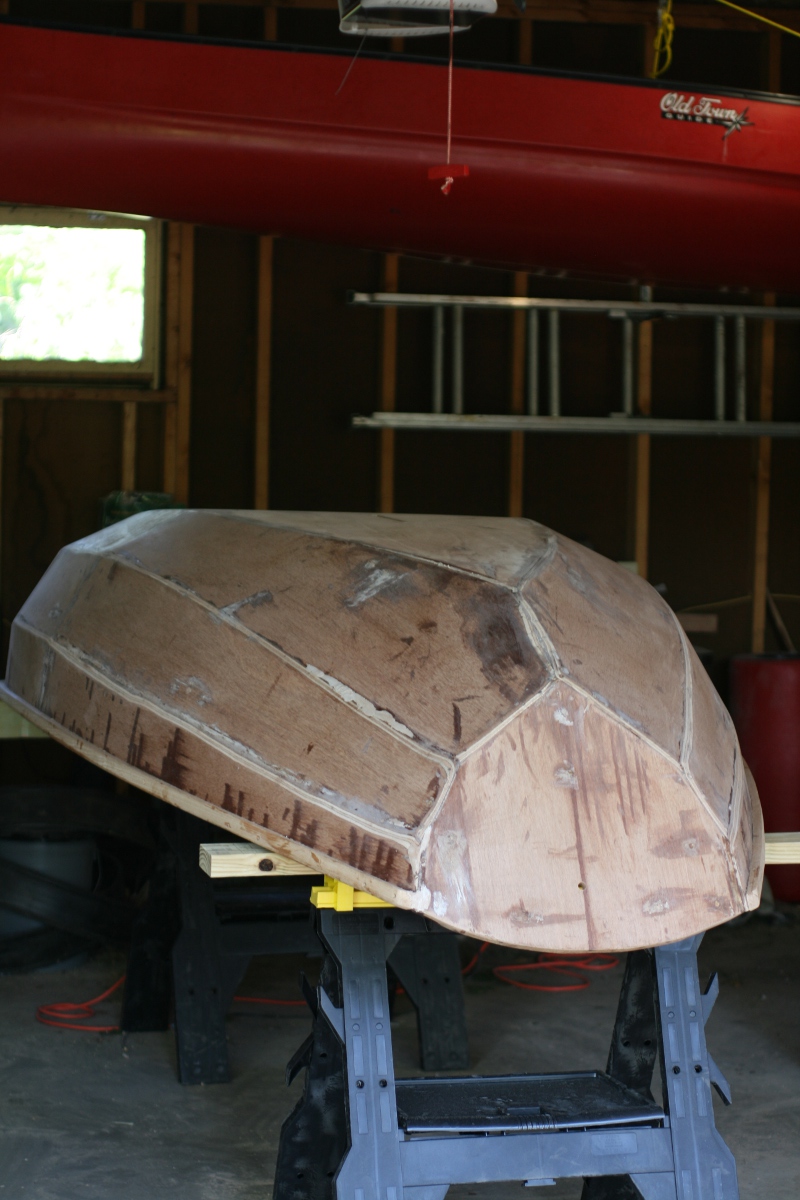
... on Typo Lake. The dagger board trunk is finally not bleeding water from the corners. Read something on one of the wooden boat forums about using pressure (think they recommended a blow dryer) to cram caulk or resin up into a leak. After sanding down with a shim covered in paper towels and sandpaper, I applied 3M 5800 caulk liberally both around the outside of the bedlogs as well as the inside of the trunk/seam of the hull and bedlogs/anywhere that looked like it could leak.
I then applied a duct tape patch to the daggerboard socket at the bottom of the boat and the top of the trunk, leaving just enough room for a duct tape-wrapped tube, which I connected to a shop vac. I threw the shop vac on reverse, and while there were a few leaks allowing the air to get out (which I wanted... didn't want to generate enough pressure to do damage,) I believe it also created enough pressure to force the caulk up into the leaks.
Typo Lake is down, by the way. Way down. Damn this drought.
Showing posts with label nautical anatomy. Show all posts
Monday, September 3, 2012
Sunday, August 26, 2012
Leaky Daggerboard Trunk and Other Rites of Passage
Sunday, May 13, 2012
Mast Step Reinforcement
Considering how thin the mast step is along the bow transom, we thought it might be a good idea to reinforce it with a small oak block. My father cut it, I routed and polished it up. Ready to be mounted.
Labels:
boatbuilding,
nautical anatomy,
nutshell pram,
spring
Saturday, May 12, 2012
Building the Nutshell Pram
Puttied up screw holes, polished down the hull and seats with 220 and 400-grit sandpaper, coated the seats in three coats of high-gloss varnish.
Seldom get a good, full-body shot of the boat. Here she is, seen from the prow. Note that the hole in the bow transom supports the painter; a rope tied to the forekeel.
Labels:
boatbuilding,
nautical anatomy,
ropes,
spring
Thursday, May 10, 2012
Mast Building: Getting it to fit in the mast step
Spent about an hour and a half whittling it down with a power planer and random orbit sander to get it to fit in the mast step. Next time going to save myself the time by originally cutting the mast about 1/10th smaller than is absolutely needed. Will also help make way for the varnish.
Labels:
mastmaking,
nautical anatomy,
nutshell pram,
spring
Saturday, April 28, 2012
Mast-Making: The Eureka Moment
I've tried various things to clamp my mast in place while allowing it enough give to turn when a reasonable degree of pressure is applied.
I attempted to clamp it (this failed; every clamp in my arsenal is intended to attach rectangles to other rectangles; they either fall off or need to be constantly adjusted.)
I attempted to screw its ends into sawhorses and make it turn like a 10' lathe (the screws came loose or simply snapped.)
May have found a simple solution; place the mast on the sawhorse and sandwich it between two chunks of 2X4. Adding a shop cloth makes it a little less wobbly and protects against gouging and scratching.
Labels:
boatbuilding,
mastmaking,
nautical anatomy,
nutshell pram
Wednesday, April 25, 2012
Mast Making: Knotty Procedures
I'm not sure if there's a SOP for knots when it comes to mast making. Perhaps the protocol is "just don't buy wood with knots in it." Perhaps making a mast out of a recently felled Sitka Spruce (as opposed to a kiln-dried construction-grade 4X4) would make the knots less likely to rattle their way out as the mast is shaved and sanded into shape.
I personally chose to ignore some knots (like the top one) because they were too shallow to be much of a consideration. One other (the one at bottom) was too deep to be ignored, and has been braced with epoxy and a little scrapwood.If the mast breaks in the middle of the lake and someone takes a gaff to the eye (and dies,) I guess we'll know I did something wrong.
Labels:
boatbuilding,
mastmaking,
nautical anatomy,
nutshell pram,
spring
Tuesday, April 24, 2012
There's Little Difference Between Tradition and Frugality
Labels:
boatbuilding,
nautical anatomy,
spring
Mast Making (cont)
Found that drawing a circle on either end of the mast can be extremely helpful in getting a general idea of its curvature in relation to your notion of a perfect circle.
Labels:
boatbuilding,
mastmaking,
nautical anatomy,
nutshell pram,
spring
Monday, April 23, 2012
Mast making Pt 4: Getting the Mast to Turn (Controllably) while working on it.
I've tried a lot of ways of anchoring the mast, and generally speaking, if you're not too worried about turning it while you're working (this is almost a must when sanding,) I found that l-clamps work the best. During the sanding process, I attempted to screw it into the saw horses. This was somewhat difficult as getting it screwed into the center point of the mast was difficult, and depending on which way you turn, the screws will generally want to either want to tighten or come loose. That being said, it worked alright.
Here's the process I used:
- Center the sawhorses, and make a lateral line on them.
- Measure up a certain amount from the floor. Where this line crosses the lateral line, drill a hole. Make sure the hole is level.
- Drill a level hole through the centers of the mast.
- Screw through the sawhorses into the center hole of the masts.
This is really pretty simple, though I could have improved it by using bolts and washers (to allow the bolts and mast to turn together,) and by bracing the horses with sandbags to keep them steady.
Update: This failed. Badly. The screws came loose or snapped altogether. Considered bolts, but this would have meant boring fairly large holes into the ends of the mast. Figured out a fairly simple solution here.
Labels:
boatbuilding,
mastmaking,
nautical anatomy,
nutshell pram,
spring
Sunday, April 22, 2012
Mast making Pt 3
Labels:
boatbuilding,
mastmaking,
nautical anatomy,
nutshell pram,
spring
Saturday, April 21, 2012
Mast making Pt 2
Labels:
boatbuilding,
mastmaking,
nautical anatomy,
nutshell pram,
spring
Monday, April 16, 2012
Masts and things
New halyards and sheets for the Springtide. Made slip arrangements as well. Have been planing down the Amanda Louise mast out of a solid 4X4. I made one attempt with Wooden Boat Works' instructions for cutting the Peapod mast, but found it was too difficult to get the equal angles with a table saw. Ended up using the instructions found here. While I made an honest go with a hand plane, I ended up using the power planer in the end, and it went pretty smoothly.
Labels:
boatbuilding,
mastmaking,
nautical anatomy,
nutshell pram,
spring
Sunday, March 18, 2012
Tuesday, March 13, 2012
Fid-ling about
The first step in learning to sew a sail is learnign to sew a ditty bag. What do you need to sew a ditty bag? Well, a needle, some marline and a yard of canvas (all commercially available,) some beeswax (got plenty of that,) and a fid (think of it like a rounded, blunt wooden stake.) As you can't find proper fids on Amazon these days, this is my first attempt at carving one out of 3/4" oak. I'm fairly okay with the whittling portion. Still need to sand it down quite a bit.
Labels:
hardware,
nautical anatomy,
sailmaking,
spring,
starting out
Sunday, August 29, 2010
The Don't Call it Breezy Point for Nothing!
Had a very educational sail this weekend. As the winds were gusting at around 25, we ran with the storm jib, and got an excellent lesson in leeway as we tried to pass a rock reef (eventually had to wear around and make another pass.) Practiced shifting the crew's weight around during strong gusts. By hiking over the edge of the boat, I was able to shift the weight enough to even it out and take a lot of the strain off the tiller.
With its island and rock reefs, Pelican Lake really is a great lake to learn sailing, and particularly to learn piloting (the art of navigating obstacles and shallows.) We would not be learning as much about piloting on a "blue water sailing" sort of lake like Mille Lacs, though we'd likely have to content with heavier winds and taller waves.
Labels:
kinds of sail,
nautical anatomy,
pelican lake,
summer,
weather
Sunday, June 6, 2010
Heavy Weather
Made two attempts to circle Gooseberry Island, both in gusty winds that swirled from the NW to W. The lower part of the circle was fine, even comfortable. Once we attempted to head back to the W we had to tack from NNW to almost straight S. Could bear SW by loosenign up the sheets and spilling wind, but the boat was overpressed with canvas when gusts hit, carrying the head to S or even SE despite the tiller being hard-over. Our only options were to run back around the island and shoot straight N through the channel between Gooseberry and Breezy Point, or complete a long series of NW to S legs.
This is what age-of-sail sailors called "over-presssed," and is why much larger vessels would only carry only staysails in heavy winds. These scraps of heavy canvas were more than enough to keep the ship going at top speed, but not enough to overload the boat, causing it to heel dangerously. A storm jib would be an excellent investment in this case, allowing us to travel much closer to a heavy wind.
Labels:
history,
nautical anatomy,
pelican lake,
points of sail,
summer
Thursday, July 2, 2009
Bower Anchor
Many modern boats carry two anchors; a bower and a kedge. A bower, like the one seen above, is typically the meatier of the two, while the kedge is often an anchor used for stability or maneuvering. In the case of maneuvering or as 'kedging' or 'warping' as it was sometimes called, a boat would be lowered from the main vessel with the anchor, which was dropped some distance away. The crew aboard the main vessel would then ply the capstan, and the rode (cable attached to the anchor) would be haulled in, pulling the vessel in the direction of the anchor. This technique could be used to safely manuever through crowded harbors, progress through doldrums, angle the vessel to gain some tactical advantage in combat, or to dislodge a vessel that has run aground.
Kedging is still used in modern times; though with the advent of the engine for manuevering, it is normally only used to dislodge smaller vessels that have run aground. Boats too small to carry a dinghy (like ours) would usually do this by having one of its crew jump out and pull the anchor (usually floated on a life vest) far enough out to drop. Our kedge is a slightly smaller anchor I used to use on our rowboat.
The anchor seen above is a fluke or danforth design weighing about 40 lbs. The hinged flukes at the crown of the anchor dig into the seabed, and once imbeded can provide an enormous amount of resistance. They're also fairly compact and easy to stow.
Labels:
history,
nautical anatomy,
terminology
Subscribe to:
Posts (Atom)